
Richard Thaler (source: nobelprize.org)
“All Economics will be as behavioral as it needs to be. And those who have been stubbornly clinging to an imaginary world that consists only of Econs will be waving a white flag, rather than an invisible hand.”
Economics being the giant of the Social Sciences, it is quite ironic that the first time behavioral aspects were taken into account was in the 1970s with RICHARD THALER and his attempt to merge psychological tools in thinking about economic problems.
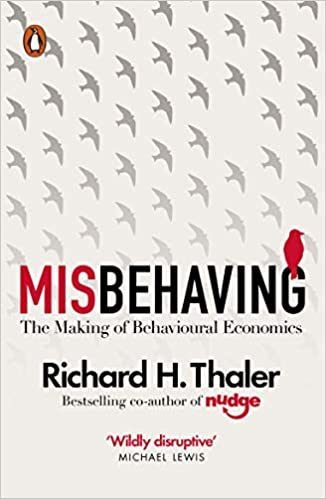
As a book, Thaler has artfully guided it to accommodate the entire stream of Behavioral Economics from its birth as mere thought experiments to its wide acceptance throughout academia. The first half of the book deals with the inception and certain experiments that reassured the need for accounting behavioral tools in empirical economic research to its major debates and then the emergence of an accepted whole new field, making way to further bigger applications like in Finance (Behavioral Finance) and Policy making first in UK and then in US (Behavioral Insights Team). The book ends on a note of how behavioral applications in Macroeconomics are evident yet not perused much by academics yet, however not before with mentions of Nudging (another bestseller of Thaler) a concept that too utilizes the behavioral aspect of economics and tries to incorporate economic (profitable) decision-making in people and markets through the simpler nudges (push).
The book follows a course that of merely three broad aspects (also summarized by Thaler himself at the end):
- Observations to identify the existence of an invisible hand
- Data Collection to ensure against confirmation bias and predict the rights over wrongs through documentation
- Speak up and let your findings be known against the existing prejudices of the “unrealism of hyperrational models”
For someone looking for a awe-inspiring artistic storytelling like ones commonly found in books of development economics, this might not be one, as misbehaving tracks only cases where consideration of behavioral aspect has led to or would have led to rather improved outcomes and hence most case studies are based on people, firms and/or governments trying to turn in a profit along with some game examples of similar nature, however the book doesn’t lack in dealing out economic morals to readers and quite evidently a major chunk of developmental economics makes a larger utilization of behavioral tools for example the famous randomized control trials.
Thaler received the Nobel Memorial Prize in Economics in 2017 for his contributions to behavioral economics.
This book is not one for a leisurely weekend reading by the layman, but someone like an academic, economics researcher or student, or a generalist with a peculiar interest to read about the birth of behavioral economics should definitely give it a go, for others picking up this book and yet finishing it inspite of losing interest mid-way and without taking back academic notes would be…wee, misbehaving.
Leave a Reply