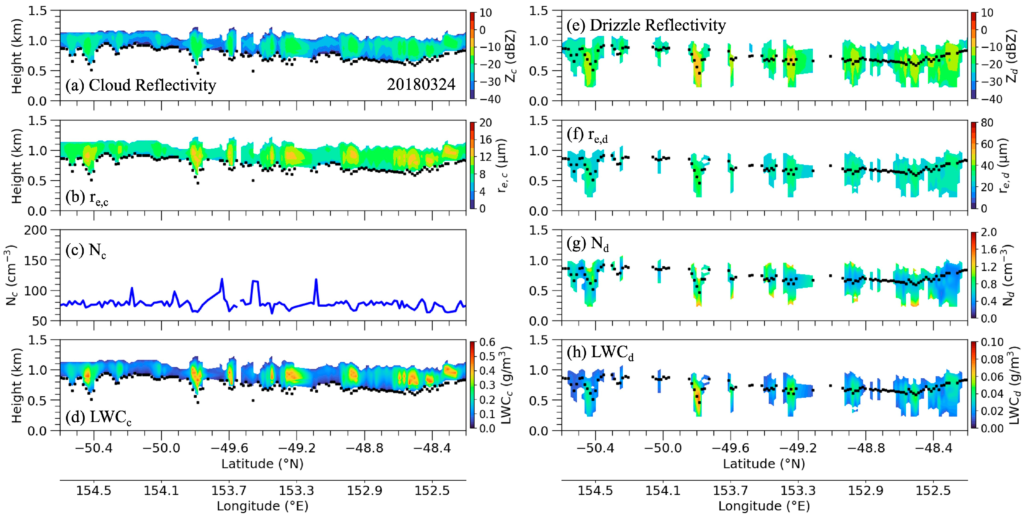
CW3E Friday Science Talk, Scripps Institution of Oceanography, UC San Diego (24 April 2026): Delivered a talk titled A Multi-Platform Observational Framework for Interpreting Marine Boundary Layer Cloud and Drizzle Microphysics, presenting some research outputs on radar-sensed microphysical retrievals of Southern Ocean cloud microphysics
Public & Institutional Talks
Career Talk at Sarala Birla Gyan Jyoti, Guwahati, India (September 2026): Invited talk and interaction with Grades XI and XII Science students, sharing my journey in atmospheric research and experiences along the path to a career in science in India and abroad.
Career Talk at Cambridge Public School, Guwahati, India (September 2026): Invited talk and interactive session with middle and senior school students, discussing scientific curiosity, higher education, and experiences from an academic journey in atmospheric research.
Graduate Instructor Sky School, University of Arizona (Spring 2026): Mentoring middle school to K-12 level during daytime, overnight, and semester-long programs, in science education and communication as well as youth mentorship across multiple scientific themes and disciplines. Aid with curriculum development, community outreach, program coordination, and more.
Star Lab Mentorship Program, University of Arizona (2025-2026): Mentored K–12 level students in independent atmospheric science research projects, guiding hypothesis development, data analysis, and synthesis towards conference-style presentations.
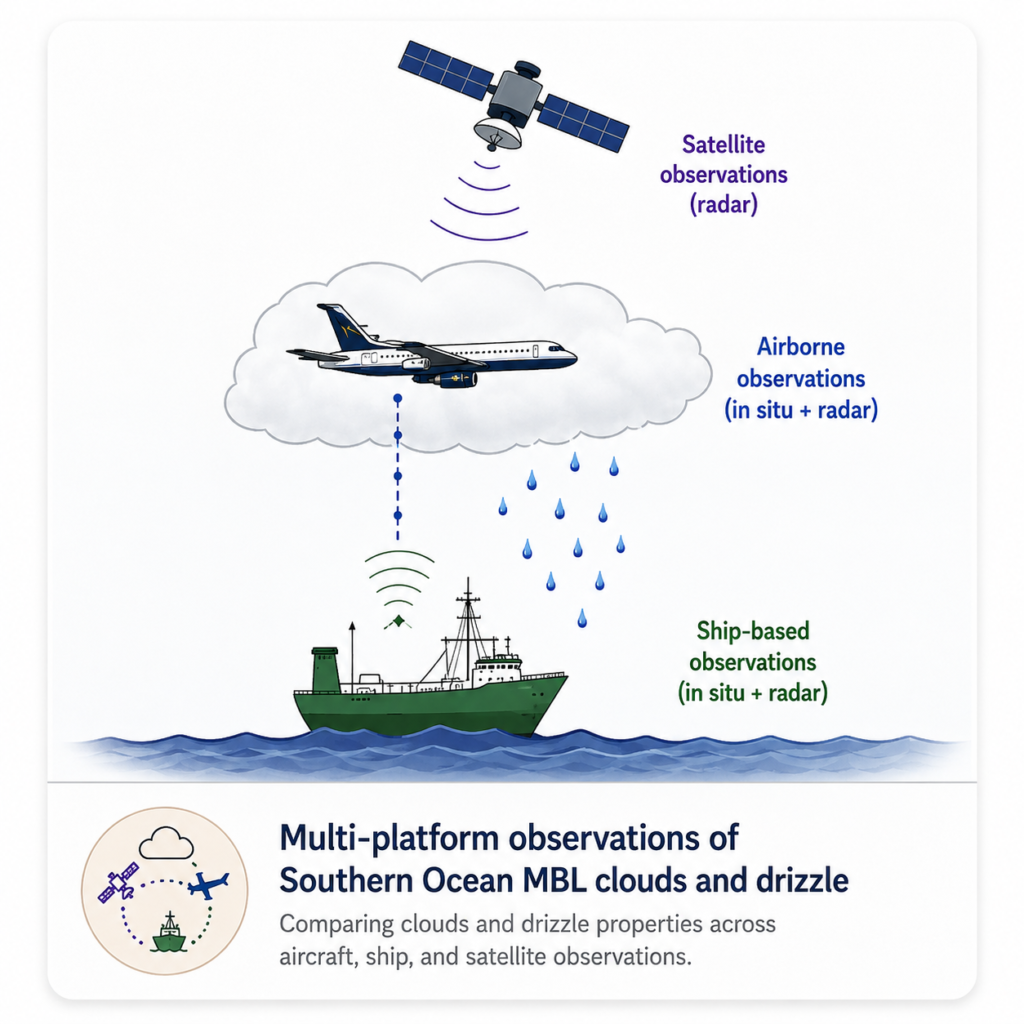
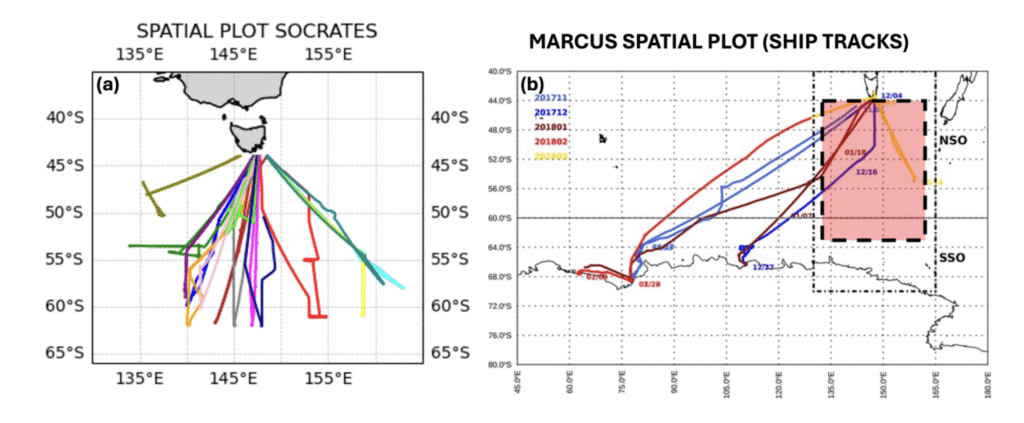
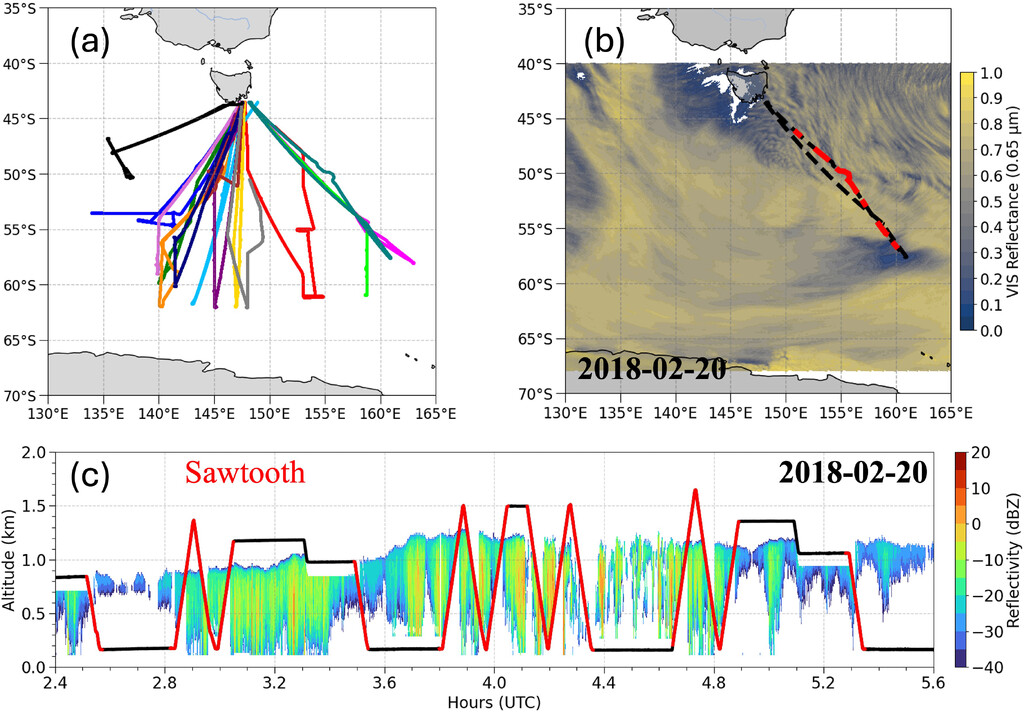
Cloud and drizzle properties in Southern Ocean (SO) marine boundary layer clouds were examined using aircraft (SOCRATES), shipborne (MARCUS), and satellite (CloudSat, EarthCARE) observations to compare how different observational platforms detect and characterize the similar cloud regimes sampled over the same SO region during the austral summer season.
What are the main findings?
A synergistic analysis of the radar-only and combined radar-lidar observations across the three platforms was conducted. The total cloud fractions (CFTs) derived from the three radars show excellent agreement. All three radars detect large drizzle drops, but marine M-WACR and airborne HCR excel at detecting smaller cloud droplets that are often missed by CloudSat CPR. Combining radar and lidar observations enhanced cloud detection by 20%–60%. The results from this study provide new insights for designing future cloud radar systems.
Consistent cloud–drizzle retrievals across platforms. The reflectivity–retrieval framework provides consistent macrophysical and microphysical properties of liquid-dominant SO MBL clouds and drizzle from all three-platform observations.
Retrieved cloud structures are physically realistic, while instrumental limitations explain most differences. The retrieved vertical distributions of cloud and drizzle properties are consistent with the dominant physical growth processes. Differences among the three platforms reflect variations in radar sensitivity, vertical resolution, and sampling strategy.
What are the implications of the main findings?
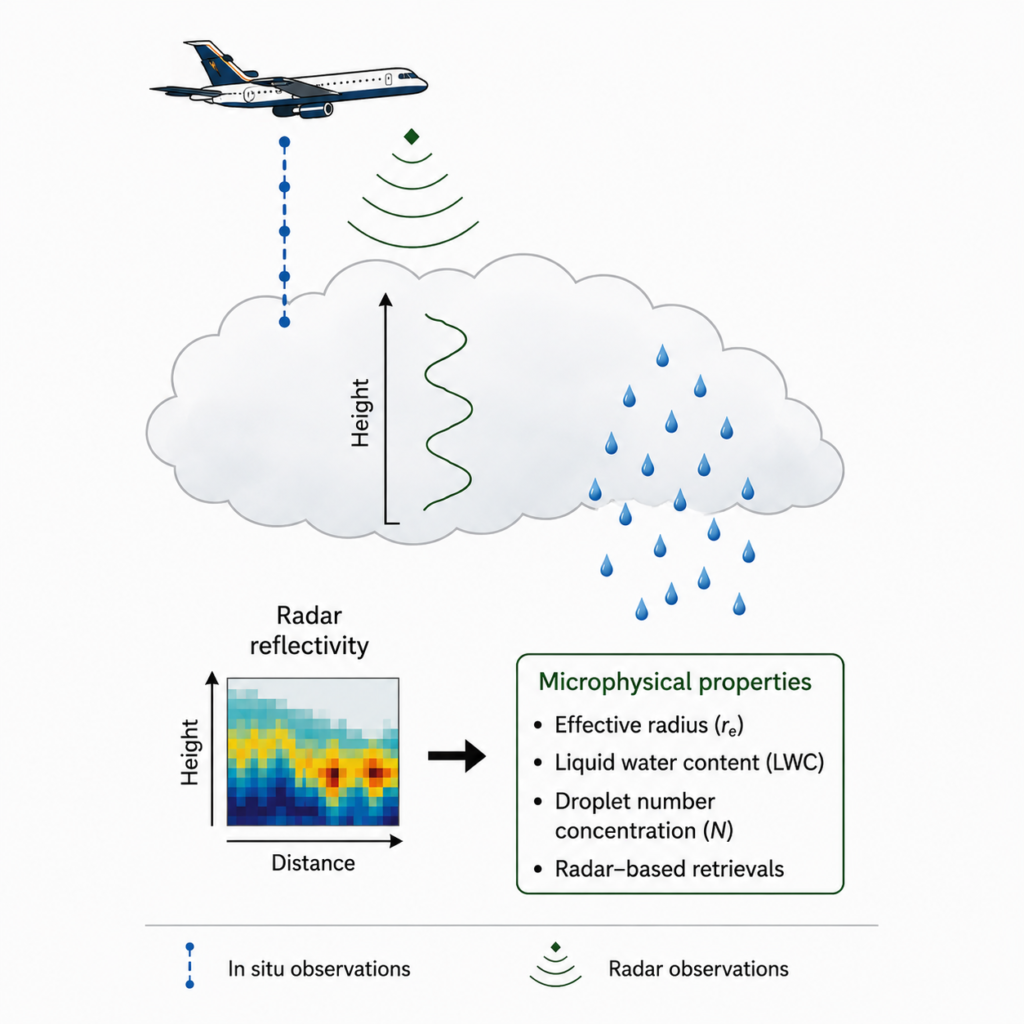
Toward unified cloud–drizzle retrievals. A single in situ-derived reflectivity–microphysics framework can be applied across airborne, ship-based, and satellite radars, enabling more coherent multi-platform cloud and drizzle climatologies.
Stronger confidence in MBL cloud process interpretation. The retrieved cloud–drizzle structures across platforms support robust physical interpretations of SO MBL clouds and provide a benchmark for improving retrievals and climate model evaluation.
Related Publication
Das, A., Dong, X., & Xi, B. (2026). Cross-Platform Comparison of Marine Boundary Layer Cloud and Drizzle Properties over the Southern Ocean Using Airborne, Shipborne, and Satellite Observations. Remote Sensing, 18(13), 2262. https://doi.org/10.3390/rs18132262
Dong, X., Das, A., Xi, B., Zheng, X., Behrangi, A., Marcovecchio, A. R., & Girone, D. J. (2025). Quantifying the differences in Southern Ocean clouds observed by radar and lidar from three platforms. Geophysical Research Letters, 52, e2024GL112079. https://doi.org/10.1029/2024GL112079
Conference Presentations:
Das, A., Dong, X., Xi, B.(2026). Investigation of Marine Boundary Layer Cloud and Drizzle Microphysics using Multi-Platform Observations over the Southern Ocean. Presentation at the 17th Conference on Cloud Physics, Session: High-Latitude Cloud, Precipitation and Radiation Processes II, AMS Madison Summit 2026. American Meteorological Society (AMS).
Dong, X., Das, A., Xi, B., Brendecke, J. (2026). Consistency of Cloud Amount and Vertical Structure Derived from Surface, Airborne, and Spaceborne Cloud Radar Measurements. Presentation at the 17th Conference on Cloud Physics, Session: Remote Sensing of Clouds I, AMS Madison Summit 2026. American Meteorological Society (AMS).
Dong, X., Das, A., Xi, B., Girone, D., Marcovecchio, A. R., Zheng, X., & Behrangi, A. (2025). Quantifying the differences of clouds observed by radar and lidar from three platforms over the Southern Ocean. Presentation at the 105th AMS Annual Meeting 2025. American Meteorological Society (AMS). https://ui.adsabs.harvard.edu/abs/2025AMS…10551658D/abstract
Understanding marine boundary layer (MBL) cloud and drizzle microphysics is essential for improving cloud–radiation feedback in models and satellite retrievals, which are sensitive to regional conditions, observation methods, and instrument characteristics. Since cloud and drizzle droplets follow distinct size distribution patterns, accurate retrievals require case-specific analyses.
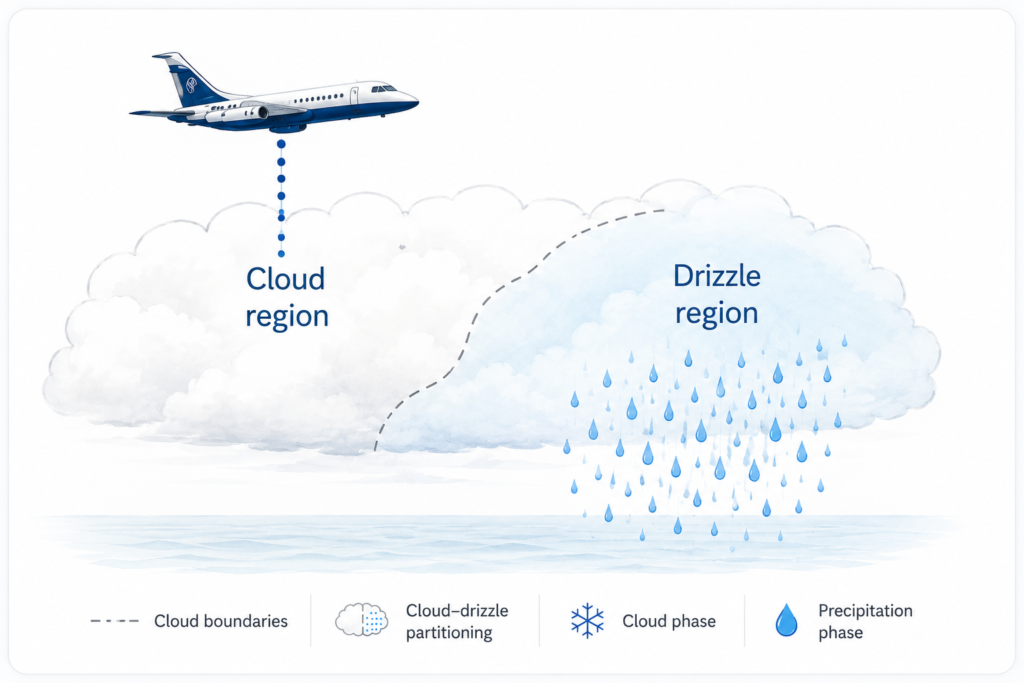
In this work, we analyze droplet size distributions from in situ cloud and drizzle probes onboard the research aircraft during the Southern Ocean Clouds, Radiation, Aerosol Transport Experimental Study (SOCRATES) airborne field campaign over the Southern Ocean. Empirical relationships linking effective radius and liquid water content to radar reflectivity are derived, providing a useful reference for retrievals across different observational platforms and microphysical regimes. The results show that microphysical properties vary systematically with reflectivity, supporting the use of radar measurements to derive time-resolved vertical profiles of cloud and drizzle structure.
Related Publication
Das, A., Dong, X., & Xi, B. (2026). Deriving Empirical Relationships between MBL Cloud Microphysical Properties and Radar Reflectivity Using Airborne In Situ Measurements over the Southern Ocean. Journal of Atmospheric and Oceanic Technology, 43(4), 425-443. https://doi.org/10.1175/JTECH-D-25-0069.1
Conference Presentations
Das, A., Dong, X., Xi, B. (2026). Investigating Marine Boundary Layer Cloud and Drizzle Microphysical Properties over the Southern Ocean Using Airborne In Situ and Radar Measurements. https://www.eol.ucar.edu/radar-technology-community-workshop-final-report-june-2026 – NSF NCAR Radar Technology Community Workshop (March 10-12, 2026), Boulder, CO.
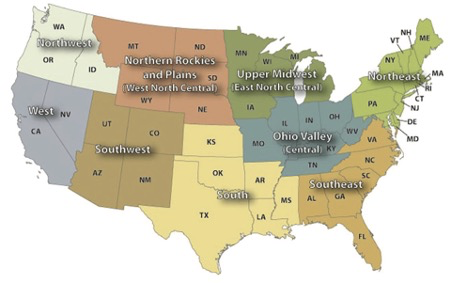
The National Centers for Environmental Information (NCEI) organizes the US into 9 climatic zones
I served as a research mentor to Bonnie Xu, a senior at University High School in Tucson, through the STAR Lab mentorship program from Fall 2025 to Spring 2026. Her interests centered on foundational topics in Earth and Atmospheric Science, and I guided her through the full research process—from refining an initial idea into a focused research question, to designing the methodology, conducting the analysis, and completing the final presentation of results.
About the Project:
A study focused on the changing climate systems and their associated regional impacts across 8 climatic zones over the continental USA (CONUS) was conducted.
Temperature and precipitation trends were analyzed over two decades: baseline (1960-1970) and 2015-2025 (modern), to highlight the limited zonal and seasonal asymmetry differences
The following research questions were evaluated:
How have seasonal mean temperature and total rainfall changed (1960–1970 vs 2015–2025)?
Are these changes seasonally asymmetric, and do asymmetries differ by zone?
Are inter-decadal seasonal shifts consistent with within-decade trends?
Which zones show expected behavior vs deviations?
About the STAR Lab Program:
The Students Taking Advantage of Research (STAR) Lab is a mentoring program at the University of Arizona that supports high school students doing authentic research projects. Although housed in the Molecular and Cellular Biology Department, STAR Lab is open to students conducting research in all fields of science, technology, engineering, and mathematics (STEM) and to students living anywhere in Arizona through both remote and in-person mentoring options.
Mentor Responsibilities:
STAR Lab mentors help students define a feasible research question and guide them through completing a scientifically rigorous project, conducted either in STAR Lab on the UA Main Campus, in a mentor’s lab, or remotely for computational work. Mentors meet with students for at least one hour per week to monitor progress and provide feedback. They review major assignments, including the research proposal, final paper, and presentation slides, to ensure accuracy and clarity. Students also receive structured support from STAR Lab staff, undergraduate facilitators, and graduate coordinators who assist with statistics, coding, and laboratory methods.
The Southern Ocean Clouds, Radiation, Aerosol Transport Experimental Study (SOCRATES) was an aircraft-based campaign (15 January–26 February 2018) that deployed in situ probes and remote sensors to investigate low-level clouds over the Southern Ocean (SO).
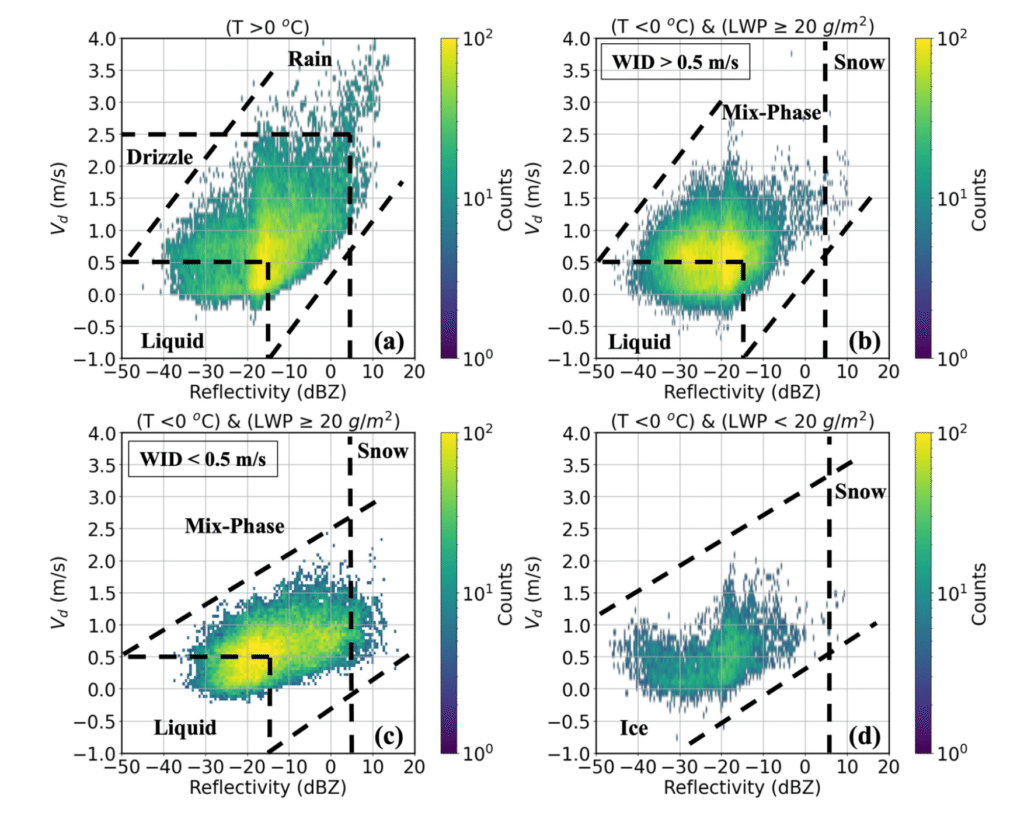
A novel methodology was developed to identify cloud boundaries and classify cloud phases in single-layer, low-level marine boundary layer (MBL) clouds below 3 km using the HIAPER Cloud Radar (HCR) and in situ measurements. Radar-derived cloud base and top heights agreed well with corresponding lidar-based and in situ estimates of cloud boundaries, with mean differences below 100 m. An empirical liquid water content–reflectivity (LWC-Z) relationship was used to retrieve the LWC and liquid water path (LWP) from HCR profiles. The cloud phase was classified using HCR measurements, temperature, and LWP, yielding 40.6% liquid, 18.3% mixed-phase, and 5.1% ice samples, along with drizzle (29.1%), rain (3.2%), and snow (3.7%) for drizzling cloud cases. The classification algorithm demonstrated good consistency with established methods.
The resulting framework provides a robust approach for characterizing Southern Ocean MBL clouds and supports future satellite retrieval and climate-model evaluation efforts.
Related Publication
Das, A., Xi, B., Zheng, X., & Dong, X. (2025). Marine Boundary Layer Cloud Boundaries and Phase Estimation Using Airborne Radar and In Situ Measurements During the SOCRATES Campaign over Southern Ocean. Atmosphere, 16(10), 1195. https://doi.org/10.3390/atmos16101195
A jobless and distraught Shankar finds refuge in Curzon Park at Chowringhee under the statue of Sir Hariram Goenka, deprived of the comforts he had as the last clerk of the last English barrister of the Calcutta High Court.His life was good until the old Barrister breathed but now he was amidst the millions shelterless whom Sir Hariram’s Statue provided a good sleeping site.Made them travel far from the land of tireless striving to the beautiful lands of dreams. One such evening at Curzon Park made Shankar face to face with an old acquaintance, a private detective Byron. By the grace of Byron, Shankar got a job at the Shahjahan Hotel. Shahjahan hotel, an establishment by a man named Simpson, was more than a mere hotel. Its walls were painted. Painted undergraces and curses. A place which had stood firm in all times and had seen too much of all times.
Shankar gets to meet people, unknown but who became the pillars of his future life. There was Satyasundar Bose whom the Shahjahan crowd has madeSata Bose, there was Marco Polo the manager whom life has blessed with much curses and grievances which the outer crowd knew nothing about.
Being posted at the reception with the brotherly Sata Bose, Shankar came to know the demonic suited crowd of Calcutta. An accursed city that shines bright, day and night, mocking upon its people. A city proudly covering its sins. Set in 1962’s Shankar with this book depicts Calcutta in a different cover. A City of dreams soaked in sins and grief. A city where people’s suits are just covers for their demonic souls. A city where money can build and destroy.
There are people, too good but sufferers of this accursed city; there is Doctor Sutherland, the angel of Suite number 2 Karabi Guha, the unsung maestro of Shahjahan P.C Gomez, the simple Nityahari, Connie and Lambreta whose lives are mere melancholy, the air hostess Sujata Mitra ……….all suppressed under the agonies of life but still keeping the hustle on.
Life goes on in Shahjahan and many stories unfold before Shankar as the thick paint of Shahjahan’s walls dissolute.
The whole book captures the audience and binds them with the characters whose life forms a ship trapped in storm and we rise and fall with the tide.The language is simple but is good enough for the inner person to rise and retaliate the anguish of life. We all being the patriarch who stays till supper.
Adi Shakti Namo Namah, Sarab Shakti Namo Namah, Prithum Bhagawati Namo Namah, Kundalini Mata Shakti, Mata Shakti Namo Namah.
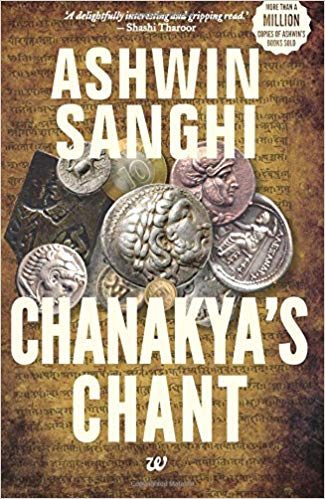
About 2300 years ago, a hunted haunted Brahmin sought revenge against the vain King of Magadha. History banters his glory as the master strategist Chanakya who uprooted vanity and immorality from the world’s most powerful empire, and created an unified Bharata through ways not much high on moral grounds. Lecherous politics plays prime as history recreates Chanakya in Pandit Gangasagar Mishra of present day. Gangasagar through his will, wit and the most strong of all – the power of renunciation strives successfully to instil his protégé Chandini Gupta as the most powerful person of theworld’s largest democracy. What ensues next turns the reader into a silent characterset in the book–depicted events, as the political battle rages with its fineflames of wit, humour, astonishment, surprises and sacrificial innocent deathsor prized murder for clearing the path to target.
The story revolves simultaneously along both the facets – Chanakya in past and Pandit Gangasagar of present. The book has been the result of the author’s committed research.
The power of politics have been well presented with its dirtiest stakes well demonstrated and implemented by both the protagonists in this cold blooded battle for power in the right sense but through wrong means as it is said “the ends justify the means”.
Shakti triumphs Shiva in the present age as Gangasagar presents Chankya’s wisdom to uplift a woman as per Suvasini’s curse thousand years back.
The language used is simple yet each paragraph gives a new tinge to the story. Overall, the book makes for a fast-paced, gripping read which grasp the reader by their most responsive nerve. This book is a must read for conspiracy seekers.
This 346-page book might be the longest I ever took to read and might be the longest to stay with me. In the words of Nobel laureate Hans Bethe “There are two types of genius. Ordinary geniuses do great things, but they leave you to believe that that you could do the same if only you worked hard enough. Then there are magicians, and you can have no idea how they do it. Feynman was a magician”
Every piece and portion of Feynman’s life comes off as a relatable story, but the magic lies at parts where Feynman exceeds your imaginary limitations and does pure magic and you are left wondering how is it possible for a common guy like Dick to do it, but yes, that’s the brilliance of Richard Feynman. You might flow through the pages and think yes he’s good or no he’s a bit of nuisance, but then he strikes you in your highest mental accord and you go back and reread portions of the story to find out what you missed about this genius.
This book cannot be called an autobiography, taped conversations with a friend of lectures delivered all over the world just changed in voice to match the need of the book, it maybe is better called a vividly painted self-portrait where all the fine lines and creases and bends are depicted accurately.
A physicist, musician, safecracker, dancer, practical joker, Feynman used to be a man of many talents, but his life might yet amaze you as to how a simple guy learnt to pick up girls at a bar to how he contributed to the atom bomb at Las Alamos and later how this genius was awarded the Nobel Prize which he thought as just an added headache. This book covers it all, giving all a reason to have a copy on their shelves.
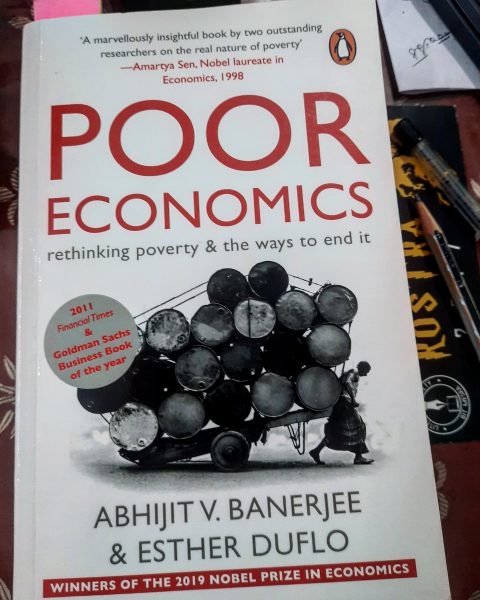
How does a book titled Poor Economics written by two very (lets say) left-leaning authors find their place as the Goldman Sach’s Business Book of the Year? Finished with this piece, an ideal starter pack on comprehending world poverty. However there aren’t any generalist theories that can bring the entire 99 cents per day population under one umbrella of economics and public policy, and this book doesn’t try to find those as well. It is more or less a comprehensive manuscript that covers data and research taken from almost half the globe over decades of sustained efforts of understanding the granularities of the socio-economic dynamics at play relevant to poverty and related issues. A major blow to many stereotypes yet never going out of logic.