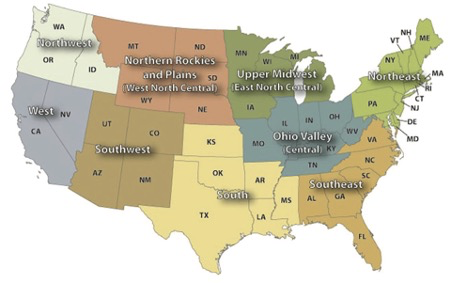
The National Centers for Environmental Information (NCEI) organizes the US into 9 climatic zones
I served as a research mentor to Bonnie Xu, a senior at University High School in Tucson, through the STAR Lab mentorship program from Fall 2025 to Spring 2026. Her interests centered on foundational topics in Earth and Atmospheric Science, and I guided her through the full research process—from refining an initial idea into a focused research question, to designing the methodology, conducting the analysis, and completing the final presentation of results.
About the Project:
- A study focused on the changing climate systems and their associated regional impacts across 8 climatic zones over the continental USA (CONUS) was conducted.
- Temperature and precipitation trends were analyzed over two decades: baseline (1960-1970) and 2015-2025 (modern), to highlight the limited zonal and seasonal asymmetry differences
- The following research questions were evaluated:
- How have seasonal mean temperature and total rainfall changed (1960–1970 vs 2015–2025)?
- Are these changes seasonally asymmetric, and do asymmetries differ by zone?
- Are inter-decadal seasonal shifts consistent with within-decade trends?
- Which zones show expected behavior vs deviations?
About the STAR Lab Program:
The Students Taking Advantage of Research (STAR) Lab is a mentoring program at the University of Arizona that supports high school students doing authentic research projects. Although housed in the Molecular and Cellular Biology Department, STAR Lab is open to students conducting research in all fields of science, technology, engineering, and mathematics (STEM) and to students living anywhere in Arizona through both remote and in-person mentoring options.
Mentor Responsibilities:
STAR Lab mentors help students define a feasible research question and guide them through completing a scientifically rigorous project, conducted either in STAR Lab on the UA Main Campus, in a mentor’s lab, or remotely for computational work. Mentors meet with students for at least one hour per week to monitor progress and provide feedback. They review major assignments, including the research proposal, final paper, and presentation slides, to ensure accuracy and clarity. Students also receive structured support from STAR Lab staff, undergraduate facilitators, and graduate coordinators who assist with statistics, coding, and laboratory methods.
Leave a Reply