Deriving Empirical Relationships between MBL Cloud Microphysical Properties and Radar Reflectivity Using Airborne In Situ Measurements over the Southern Ocean

Find it Online: https://doi.org/10.1175/JTECH-D-25-0069.1

Abstract

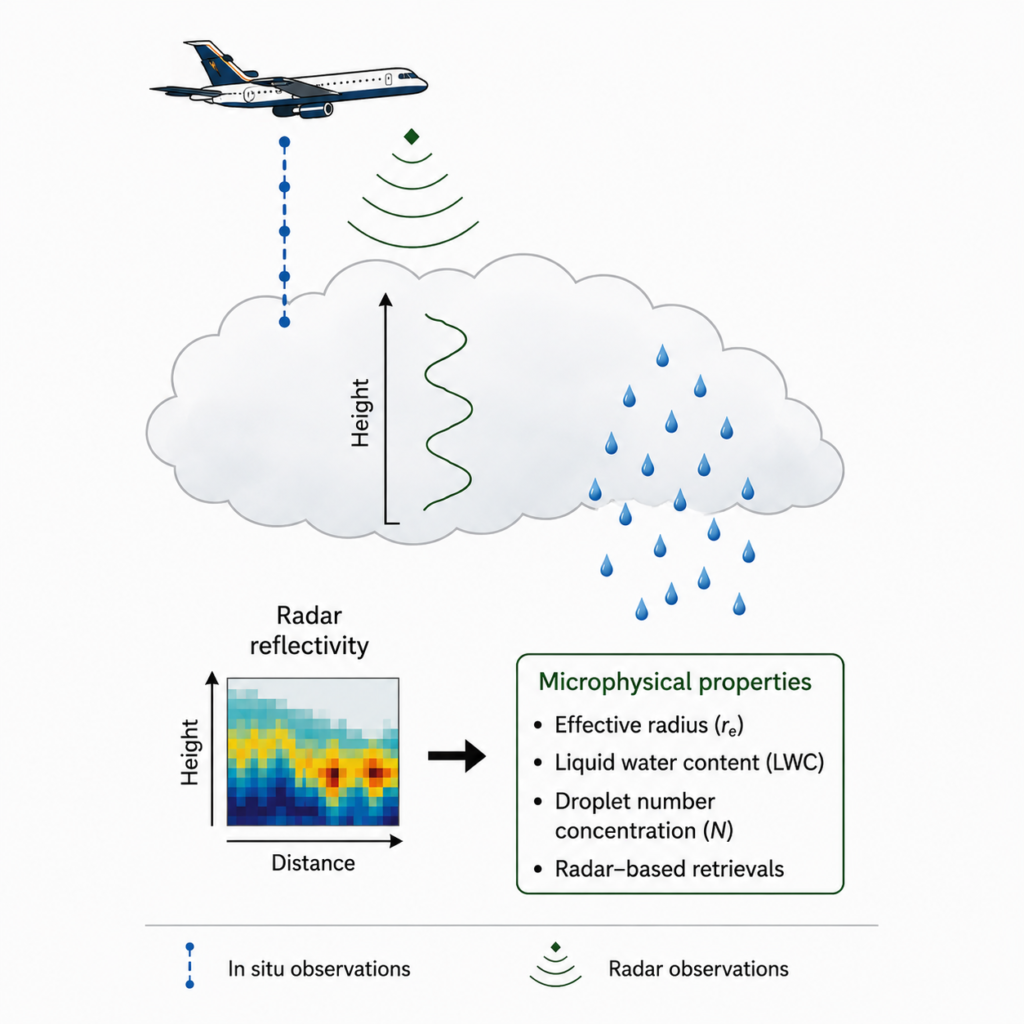
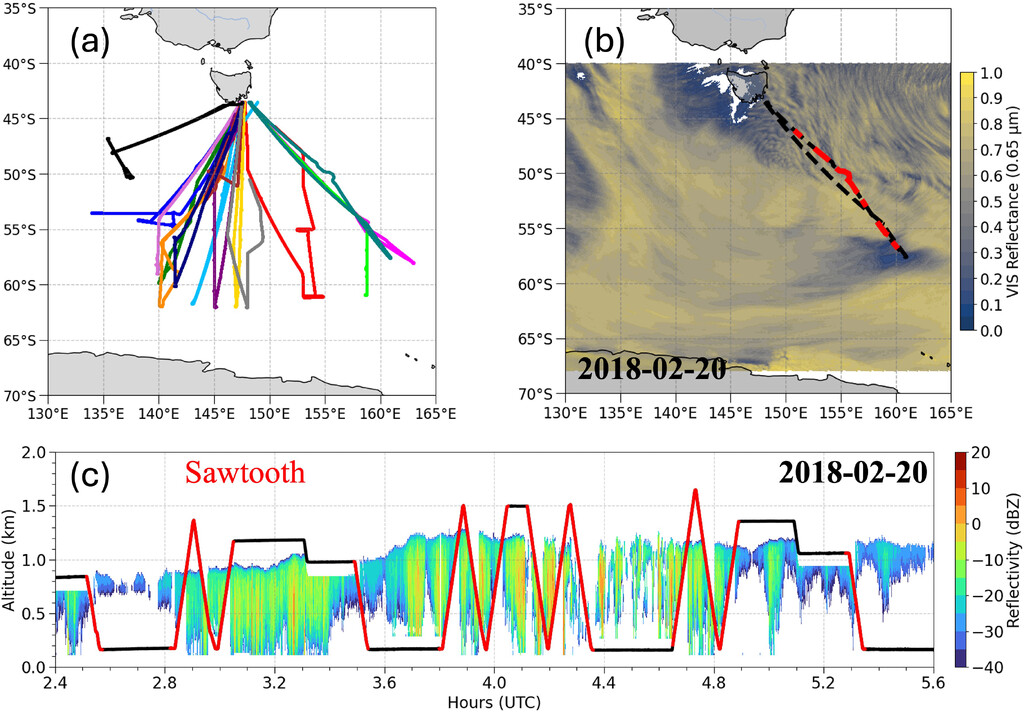
Accurate representation of marine boundary layer (MBL) cloud and drizzle microphysics is essential for improving cloud–radiation feedback in models and satellite retrievals. This study derived empirical relationships to estimate cloud and drizzle microphysical properties—effective radius (re) and liquid water content (LWC)—from reflectivity (ZdBZ) using aircraft measurements during the Southern Ocean Clouds, Radiation, Aerosol Transport Experimental Study (SOCRATES) campaign. In situ cloud and drizzle droplet size distributions (DSDs) were measured by the cloud droplet probe (CDP; 2–40 μm) and two-dimensional stereo (2D-S) probe (40–400 μm) onboard aircraft and analyzed assuming lognormal and gamma size distributions, respectively. Empirical relationships re = A exp(0.0384 × ZdBZ) and LWC = B exp(0.115 × ZdBZ) were derived, with coefficients A = 23.02 ± 2.4 and B = 2.70 ± 0.95 for clouds and A = 49.81 ± 3.5 and B = 0.15 ± 0.11 for drizzle. Sensitivity analyses show that A and B vary strongly with reflectivity but only weakly with droplet number or size distribution. The derived relationships were applied to the 94-GHz High-Performance Instrumented Airborne Platform for Environmental Research (HIAPER) Cloud Radar (HCR) reflectivity measurements during SOCRATES. The retrieved re and LWC values show excellent agreement with in situ estimates, exhibiting mean differences below 10%. Further implementation using Marine W-Band Atmospheric Radiation Measurement (ARM) Cloud Radar (M-WACR) reflectivity measurements during the Measurements of Aerosols, Radiation, and Clouds over the Southern Ocean (MARCUS) campaign yielded results consistent with existing retrieval approaches (mean differences < 20%). These findings demonstrate that the derived empirical relationships provide a reliable and broadly applicable framework for retrieving MBL cloud and drizzle properties across different observational platforms and marine climatic regimes.

Significance Statement

Understanding cloud and drizzle microphysics is essential for improving climate model predictions, which are sensitive to regional conditions, observation methods, and instrument characteristics. Since cloud and drizzle droplets follow distinct size distribution patterns, accurate retrievals require case-specific analyses. In this study, we analyze droplet size distributions from in situ cloud and drizzle probes onboard research aircraft during the Southern Ocean Clouds, Radiation, Aerosol Transport Experimental Study (SOCRATES) campaign over the Southern Ocean. Empirical relationships linking effective radius and liquid water content to radar reflectivity are derived, providing a useful reference for retrievals across different observational platforms and microphysical regimes. The results show that microphysical properties vary systematically with reflectivity, supporting the use of radar measurements to derive time-resolved vertical profiles of cloud and drizzle structure.
Cite Paper: Das, A., Dong, X., & Xi, B. (2026). Deriving Empirical Relationships between MBL Cloud Microphysical Properties and Radar Reflectivity Using Airborne In Situ Measurements over the Southern Ocean. Journal of Atmospheric and Oceanic Technology43(4), 425-443. https://doi.org/10.1175/JTECH-D-25-0069.1

Conference Presentation

Das, A., Dong, X., Xi, B. (2026). Investigating Marine Boundary Layer Cloud and Drizzle Microphysical Properties over the Southern Ocean Using Airborne In Situ and Radar Measurements. https://www.eol.ucar.edu/radar-technology-community-workshop-final-report-june-2026NSF NCAR Radar Technology Community Workshop (March 10-12, 2026), Boulder, CO.