Highlights
The Southern Ocean Clouds, Radiation, Aerosol Transport Experimental Study (SOCRATES) was an aircraft-based campaign (15 January–26 February 2018) that deployed in situ probes and remote sensors to investigate low-level clouds over the Southern Ocean (SO).
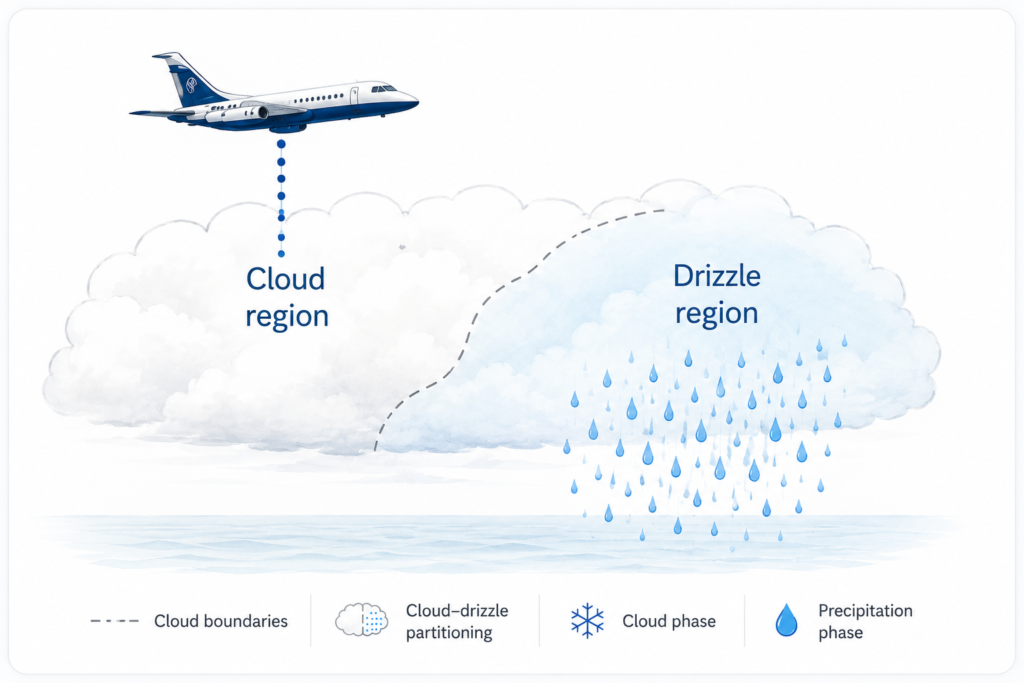
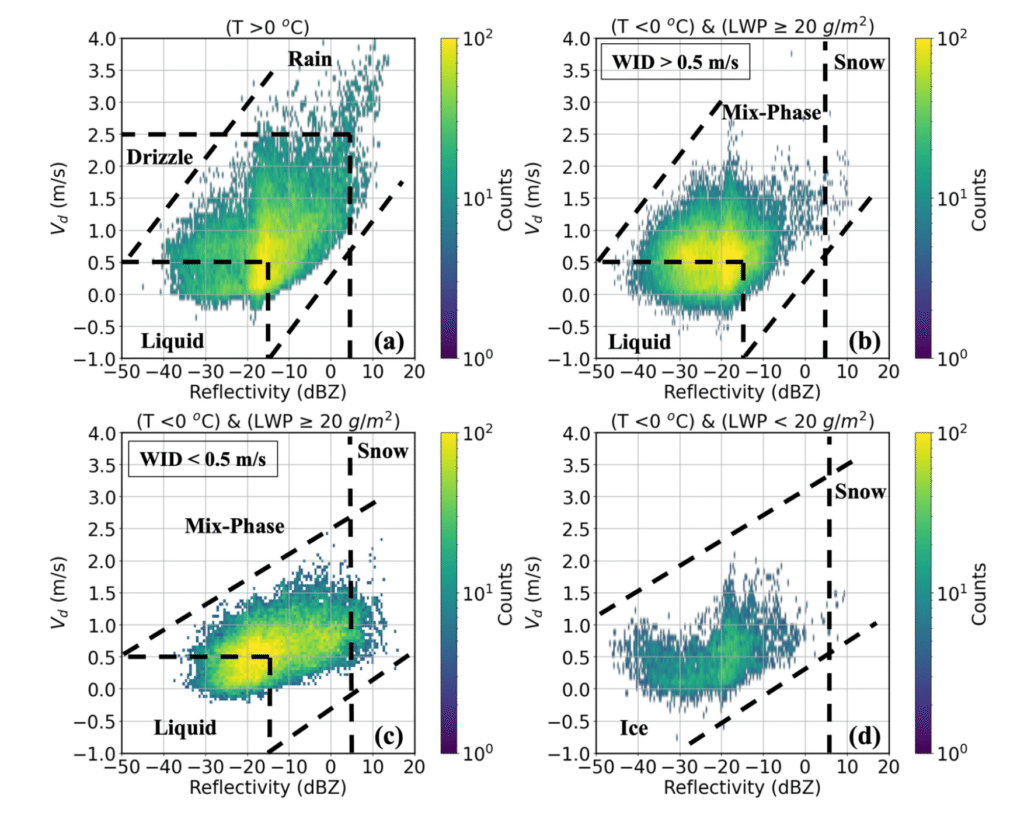
A novel methodology was developed to identify cloud boundaries and classify cloud phases in single-layer, low-level marine boundary layer (MBL) clouds below 3 km using the HIAPER Cloud Radar (HCR) and in situ measurements. Radar-derived cloud base and top heights agreed well with corresponding lidar-based and in situ estimates of cloud boundaries, with mean differences below 100 m. An empirical liquid water content–reflectivity (LWC-Z) relationship was used to retrieve the LWC and liquid water path (LWP) from HCR profiles. The cloud phase was classified using HCR measurements, temperature, and LWP, yielding 40.6% liquid, 18.3% mixed-phase, and 5.1% ice samples, along with drizzle (29.1%), rain (3.2%), and snow (3.7%) for drizzling cloud cases. The classification algorithm demonstrated good consistency with established methods.
The resulting framework provides a robust approach for characterizing Southern Ocean MBL clouds and supports future satellite retrieval and climate-model evaluation efforts.
Related Publication
- Das, A., Xi, B., Zheng, X., & Dong, X. (2025). Marine Boundary Layer Cloud Boundaries and Phase Estimation Using Airborne Radar and In Situ Measurements During the SOCRATES Campaign over Southern Ocean. Atmosphere, 16(10), 1195. https://doi.org/10.3390/atmos16101195
Conference Presentation:
- Das, A., Xi, B., Zheng, X., & Dong, X. (2024, December). Estimating cloud boundaries, phase, and macrophysical properties of low-level clouds using in-situ and radar measurements over the Southern Ocean during the SOCRATES campaign. In AGU Fall Meeting Abstracts (Vol. 2024, No. 1938, pp. A43A-1938).Poster abstract: https://agu.confex.com/agu/agu24/meetingapp.cgi/Paper/1573644. Poster PDF (ESSOAr): https://doi.org/10.22541/essoar.173888267.71612728/v1