Highlights
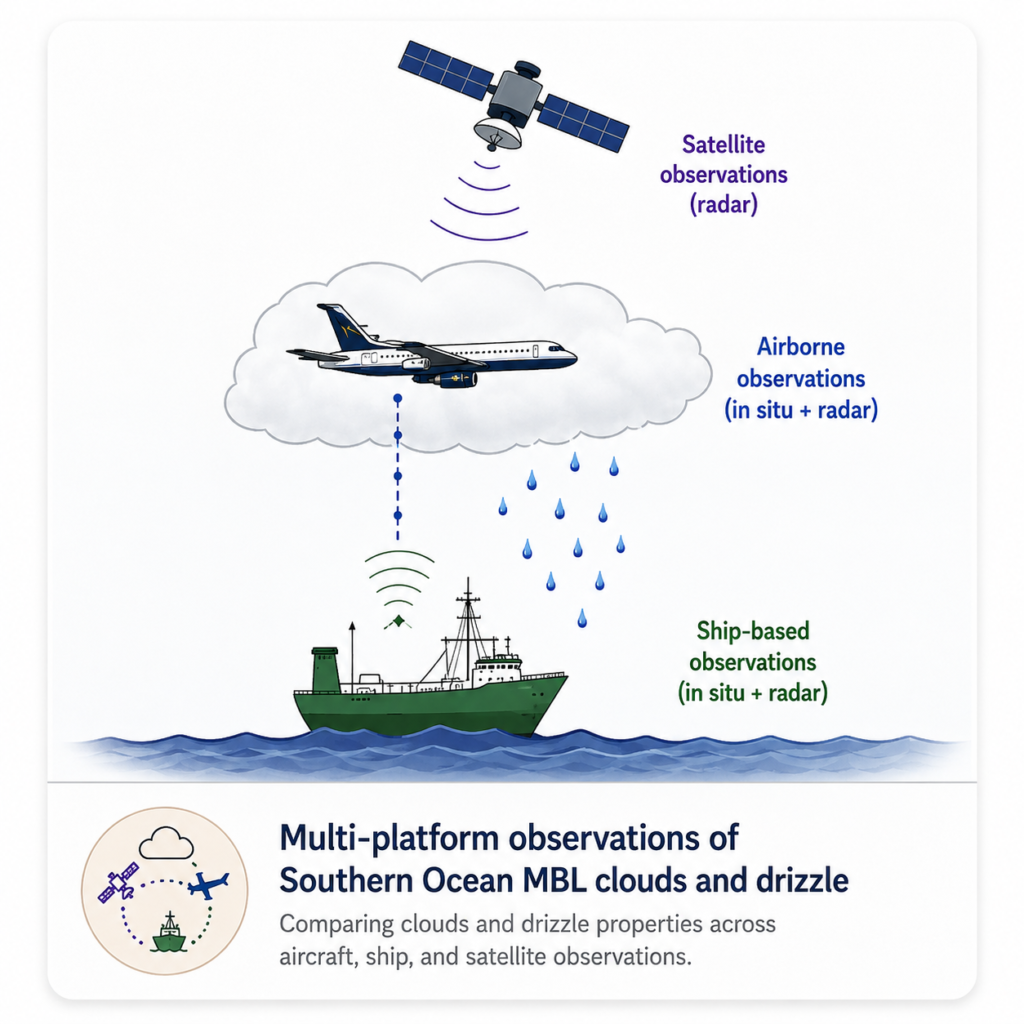
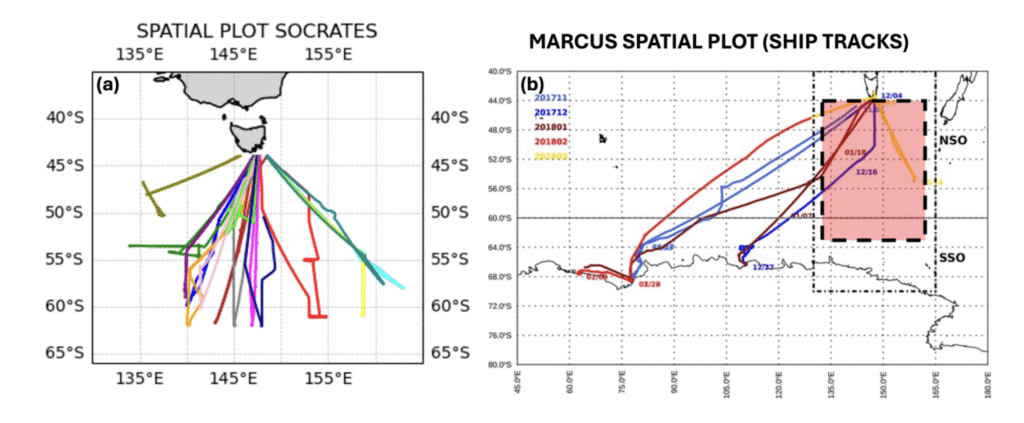
Cloud and drizzle properties in Southern Ocean (SO) marine boundary layer clouds were examined using aircraft (SOCRATES), shipborne (MARCUS), and satellite (CloudSat, EarthCARE) observations to compare how different observational platforms detect and characterize the similar cloud regimes sampled over the same SO region during the austral summer season.
What are the main findings?
- A synergistic analysis of the radar-only and combined radar-lidar observations across the three platforms was conducted. The total cloud fractions (CFTs) derived from the three radars show excellent agreement. All three radars detect large drizzle drops, but marine M-WACR and airborne HCR excel at detecting smaller cloud droplets that are often missed by CloudSat CPR. Combining radar and lidar observations enhanced cloud detection by 20%–60%. The results from this study provide new insights for designing future cloud radar systems.
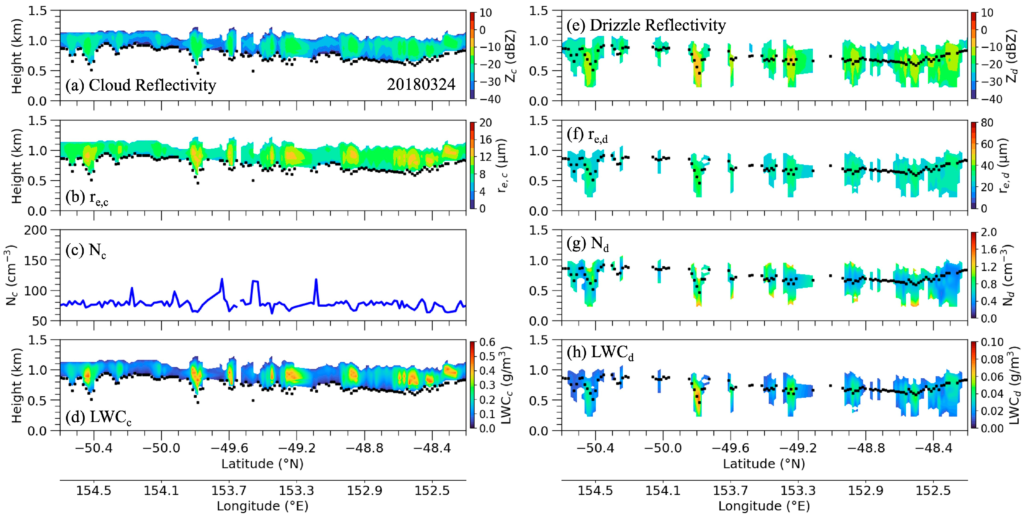
- Consistent cloud–drizzle retrievals across platforms. The reflectivity–retrieval framework provides consistent macrophysical and microphysical properties of liquid-dominant SO MBL clouds and drizzle from all three-platform observations.
- Retrieved cloud structures are physically realistic, while instrumental limitations explain most differences. The retrieved vertical distributions of cloud and drizzle properties are consistent with the dominant physical growth processes. Differences among the three platforms reflect variations in radar sensitivity, vertical resolution, and sampling strategy.
What are the implications of the main findings?
- Toward unified cloud–drizzle retrievals. A single in situ-derived reflectivity–microphysics framework can be applied across airborne, ship-based, and satellite radars, enabling more coherent multi-platform cloud and drizzle climatologies.
- Stronger confidence in MBL cloud process interpretation. The retrieved cloud–drizzle structures across platforms support robust physical interpretations of SO MBL clouds and provide a benchmark for improving retrievals and climate model evaluation.
Related Publication
- Das, A., Dong, X., & Xi, B. (2026). Cross-Platform Comparison of Marine Boundary Layer Cloud and Drizzle Properties over the Southern Ocean Using Airborne, Shipborne, and Satellite Observations. Remote Sensing, 18(13), 2262. https://doi.org/10.3390/rs18132262
- Dong, X., Das, A., Xi, B., Zheng, X., Behrangi, A., Marcovecchio, A. R., & Girone, D. J. (2025). Quantifying the differences in Southern Ocean clouds observed by radar and lidar from three platforms. Geophysical Research Letters, 52, e2024GL112079. https://doi.org/10.1029/2024GL112079
Conference Presentations:
- Das, A., Dong, X., Xi, B.(2026). Investigation of Marine Boundary Layer Cloud and Drizzle Microphysics using Multi-Platform Observations over the Southern Ocean. Presentation at the 17th Conference on Cloud Physics, Session: High-Latitude Cloud, Precipitation and Radiation Processes II, AMS Madison Summit 2026. American Meteorological Society (AMS).
- Dong, X., Das, A., Xi, B., Brendecke, J. (2026). Consistency of Cloud Amount and Vertical Structure Derived from Surface, Airborne, and Spaceborne Cloud Radar Measurements. Presentation at the 17th Conference on Cloud Physics, Session: Remote Sensing of Clouds I, AMS Madison Summit 2026. American Meteorological Society (AMS).
- Dong, X., Das, A., Xi, B., Girone, D., Marcovecchio, A. R., Zheng, X., & Behrangi, A. (2025). Quantifying the differences of clouds observed by radar and lidar from three platforms over the Southern Ocean. Presentation at the 105th AMS Annual Meeting 2025. American Meteorological Society (AMS). https://ui.adsabs.harvard.edu/abs/2025AMS…10551658D/abstract